The factory of the future will combine technological innovation, decarbonization, and modularity
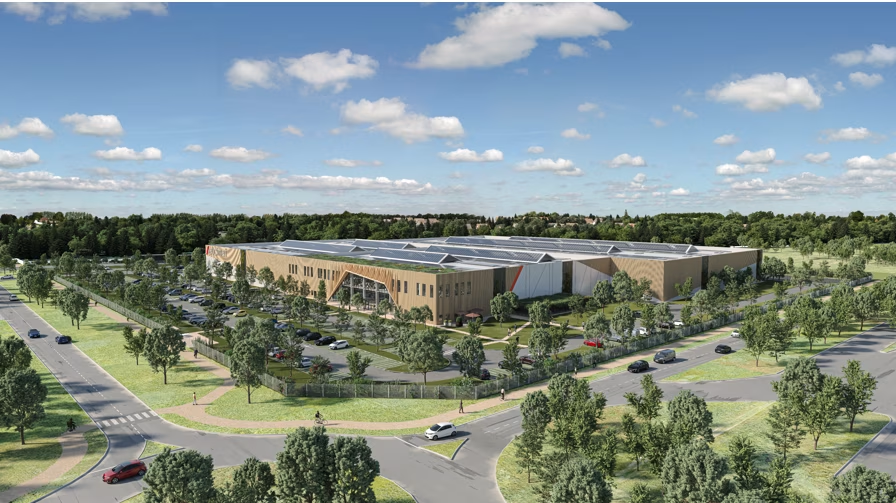
What will the factory of the future look like ?
In the industrial real estate sector, the challenge is to anticipate the reindustrialization of our regions in the face of a shortage of available land : on the one hand, by offering production units that are practically ready for use to meet the urgent needs of certain projects, and on the other hand, by planning for the long term through flexible and energy-efficient solutions.
A factory that is highly energy-efficient and has a low environmental impact.
The factory of the future must therefore be considered across its entire lifecycle.
Above all, it will offer high energy efficiency and a low environmental impact. In addition to the choice of location and the building’s orientation, care will be taken to respect existing vegetation and promote biodiversity—all elements that contribute to the site’s ecological balance.
An innovative factory combining decarbonization technology and modularity.
Second, the factory will be designed as a “Sustainable Industrial Envelope®,” combining technological innovation, decarbonization, and modularity. The goal is to enable reuse in the event of a change in activity and to prevent the creation of industrial wastelands. The goal is to adopt a standardized real estate model (with a defined structure and an adaptable cladding made from bio-based materials) for a production site that will be flexible. Additionally, this unit can be more compact and prioritize verticality to minimize the footprint.
Implementation of the Sustainable Industrial Envelope®.
Third, the Sustainable Industrial Envelope® will be designed around a digital twin to offer companies great flexibility in site infrastructure, particularly regarding utilities and energy. Regarding energy production, the use of hydrogen, geothermal energy, or photovoltaics will be made possible.
In addition, a building management system (BMS) will optimize energy consumption and enable smart control of utilities and security systems (heating, ventilation, air conditioning, lighting). This production facility will be automated as much as possible, notably through the use of automated storage and recovery systems.
Finally, the factory of the future will offer its users sustainable, low-impact mobility solutions, including electric charging stations and shared vehicles.

Laurent Khan, CEO of Elcimaï Réalisations