Reducing waste : Local communities are embracing the circular economy by expanding recycling centers

The goal of the Anti-Waste Law for a
Circular Economy is to fundamentally transform our system by setting new targets for the coming years. Many regions
are committing to a new model of production and consumption by
developing recycling centers—facilities in which Elcimaï Environnement is now a
leading expert.
Recycling centers : facilities playing a major role in the anti-waste value chain
The Anti-Waste Law for a Circular Economy aims to accelerate the shift in
production and consumption models to limit waste and preserve natural resources, biodiversity
, and the climate. It seeks to fundamentally transform our linear economy—produce,
consume, dispose—into a circular economy.
It is structured around five main pillars :
- phasing out single-use plastic,
- better informing consumers,
- combating waste and promoting inclusive reuse,
- taking action against planned obsolescence,
- improving production,
and sets new goals for the coming years :
- 5 % of household waste by 2030 to be reused or repurposed,
- a requirement to reuse, repurpose, or recycle new
non-food products intended for sale, - the option to use municipal recycling centers as collection points, a requirement
to provide a drop-off area.
In this value chain, the recycling center emerges as a key player.
Regions are taking action with the support of Elcimaï Environnement
Elcimaï Environnement, a subsidiary of the Elcimaï Group, has been developing its expertise in consulting
and engineering in the field of the circular economy and ecological transition for 35 years, from preliminary
studies to the construction of infrastructure. It is a recognized partner of public and private project
owners of all types.
Thus, the city of Gennevilliers (92) commissioned it to conduct a feasibility study for the establishment of a
recycling center with various objectives :
- economic : to create economic activities for professional integration and develop an economic model that promotes sustainable development,
- social : to create jobs for social integration and provide a solution to support local stakeholders
, - societal : to create a space for exchange and sharing on the themes of reuse and the
sharing economy, and to improve and sustain the living environment.
The city, with a population of 47,000, intends to leverage its economic dynamism to address
social challenges. It experienced 10 % growth between 2014 and 2017 and accounts for 44,000
jobs thanks to businesses that occupy two-thirds of the city’s territory.
To conduct this feasibility study, Elcimaï Environnement implemented its
proven methodology in this field, which is based on two phases of work :
- A regional assessment, including numerous interviews with local stakeholders (businesses, Chamber of Commerce and Industry, Chamber of Trades and Crafts, etc.), a community survey, monitoring of a bulky waste collection, etc., with the field investigations conducted enabling a thorough analysis of the region’s constraints and challenges ;
- collaborative work to identify and confirm the level of stakeholder engagement, determine potential synergies and complementarities among them, define the organizational arrangements for the selected site, etc.
“Our studies include an analysis of material and human resources, regulatory
constraints, and a financial analysis,” explains Fanny Champion, project manager at Elcimaï Environnement.
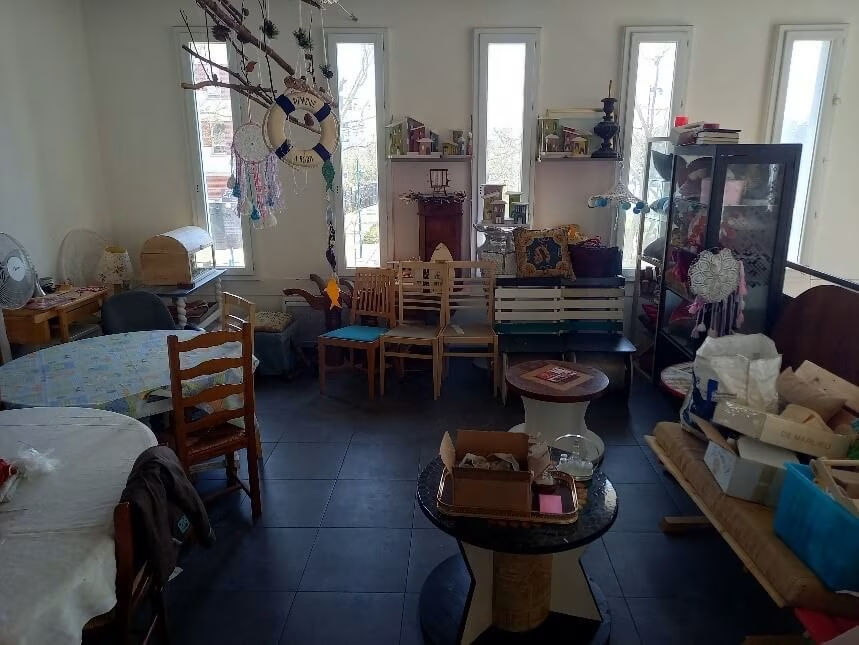
Elcimaï Environnement submitted a similar feasibility study to Calitom, which handles waste treatment
across the entire Charente region and waste collection in part
of it. The region in question covers 5,956 km² and comprises 9 EPCIs with a total population of 361,539
.
As part of the 3R call for projects led by ADEME and the Aquitaine Region, Calitom aimed
to launch one or two recycling center projects in the region to supplement
existing services. Sites had been pre-identified in the Angoulême and Confolens
areas. The feasibility study confirmed the value of establishing new facilities
in these areas, as well as fostering a collaborative dynamic among local
stakeholders : local governments, associations, businesses, etc.
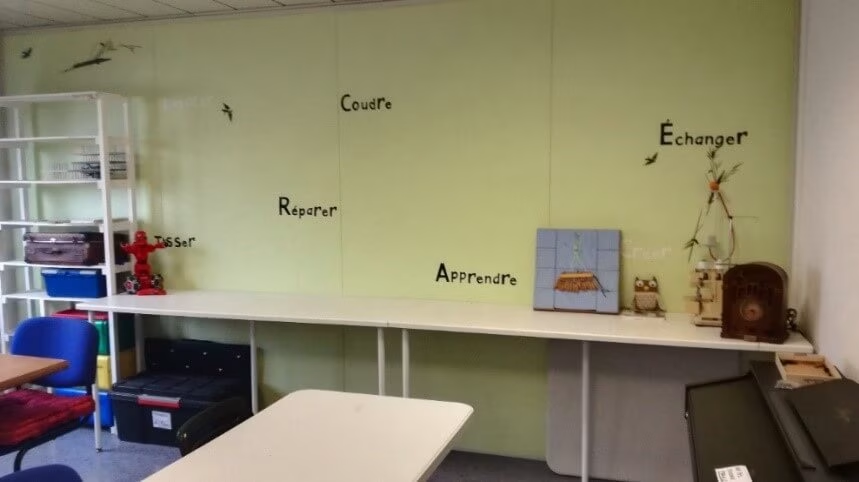
The objectives pursued by SIETREM, also supported by Elcimaï Environnement, are
aligned with those of the City of Gennevilliers and Calitom. Located in the Île-de-France region, SIETREM
covers 164 km², straddling the departments of Seine-et-Marne and Seine-Saint-Denis. It comprises 31 municipalities across 3 EPCIs, with a total population of 303,420 in 2019.
SIETREM has been strongly committed to the issue of waste reduction and recovery ; the
mission entrusted to Elcimaï Environnement was part of the ongoing work initiated several years ago
with Gustave Eiffel University, as well as the organization of pop-up recycling
centers such as the one at Cité Descartes, launched as part of European Waste Reduction
Week.
The goal was to mobilize and support stakeholders with a view to defining
a concrete and sustainable recycling center project that contributes, on its own scale, to the principles of the
“circular economy.” Today, the stakeholders involved are continuing the initiative.
The Elcimaï Group’s diverse areas of expertise also enable it to participate in
recycling center construction projects, such as the waste collection and recycling center project led by the SIOM
of the Chevreuse Valley (91).
Driven by the desire to establish a facility in its region dedicated to promoting reuse,
the SIOM of the Chevreuse Valley first issued a call for proposals to manage the
recycling center, which led to the selection of a solidarity-based economic group named “La Collective,”
bringing together three pre-existing organizations from the Île-de-France region.
With the support of the Elcimaï Group, the SIOM of the Chevreuse Valley then initiated a process to
entrust a consortium of companies with the design and construction of a waste collection center/recycling center complex
in the town of Saclay, as well as the operation of the waste collection center.
This ambitious project, the details of which were established in collaboration with the future operator
of the recycling center, will serve as a local showcase for reuse and will enable, within a facility of approximately 1,000
m², the implementation of collection, repair, storage, and awareness-raising activities.
“Today, regulations are driving the development of initiatives to promote reuse and recycling
. The discussions on this topic initiated by the local communities we support are mobilizing
a wide range of stakeholders to develop diverse projects, ranging from one-off events to the
creation of recycling center-type facilities, as well as the development of overarching strategic plans,” concludes
Fanny Champion.