Elcimaï Environnement is assisting the City of Paris in preparing for the phase-out of single-use plastics

By 2050, if nothing is done, 12 billion tons of plastic waste will have accumulated on the planet. The exponential weight of plastic in the oceans will thus be equal to or greater than that of fish.
Paris, a city free of single-use plastic by 2024
In Paris, the primary use of plastic involves packaging for single-use and disposable products. Individual bags, takeout containers, plastic bags, and disposable wrappers now account for half of the volume and one-third of the weight of trash.
The European and French regulatory framework has been evolving for several years, with the ban on single-use plastic bags since 2017, followed by disposable tableware, cotton swabs, and cosmetics containing plastic microbeads since 2020.
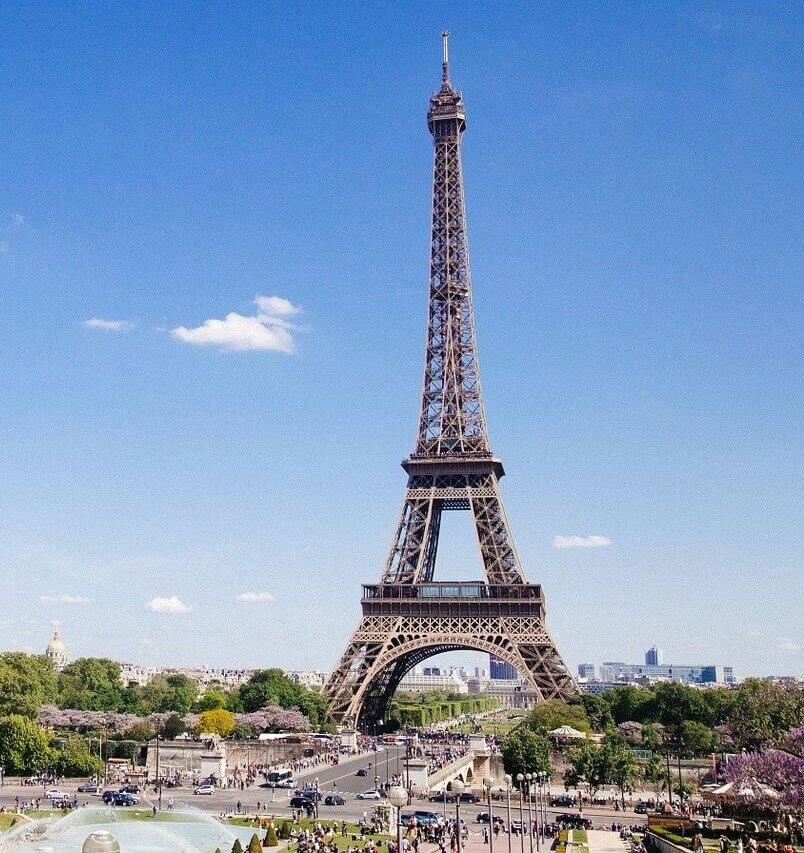
Aware of the environmental and health urgency of combating single-use plastic, the City of Paris aims to leverage the momentum of the 2024 Olympic and Paralympic Games to accelerate this change. The first measure of its “Olympic Transformations” legacy plan aims to make Paris “a city free of single-use plastic by 2024.”
To this end, it commissioned the consulting firm Elcimaï Environnement, in collaboration with AQ(T)UA, to conduct a regional assessment designed to inventory plastic material flows, from their points of use (residences, recreational areas, streets/outdoors, businesses, industry, construction, etc.) to the environmental compartments where they end up. This assessment, based on extensive literature review and numerous interviews, has just been submitted, along with recommendations. It sheds light on uses, impacts, the quantities involved, and the stakeholders concerned.
Elcimaï Environnement has submitted its environmental assessment
The assessment covers the territory of the City of Paris. It encompasses all plastics, whether used in economic activities or by households. Whether consumed in recreational areas or on the street, these plastics that are part of our daily lives are listed, and their lifecycle helps identify the stakeholders involved. It catalogs the plastic streams documented in the literature, namely consumer packaging as well as waste from economic activities (construction and public works, logistics, and construction sites), microplastics added to certain cosmetics, plastics present in sports field infrastructure, rubber left behind when vehicles brake, cigarette butts, and more.
The assessment reveals, in particular, that pollution is widespread, multifaceted, and affects all environmental compartments. Transfers from the collection system to the sewer network, from the soil to the water system, as well as transfers via air, rain, and even “improper practices” complicate efforts to reduce the amount of plastic reaching the Seine or the ground.
All environmental compartments (water, soil, air) are affected by plastic particles. If a resident uses approximately 160 kg of plastic per year, 100 g in the form of synthetic dust will enter the atmosphere, 28 g will enter the Seine, and 340 g will accumulate on the ground. For the soil, this is linked, for example, to the loss and illegal dumping of construction and demolition waste. In this case, the management of construction and demolition waste will be a major challenge in the coming years, given the construction projects to be carried out (19.5 million square meters are to be built by 2024 in Paris and Seine-Saint-Denis).
The particles found in the Seine include both packaging and bottles, as well as microparticles smaller than 5 mm—and even as small as 300 μm for textile fibers—that enter the river, carried by the sewer system. Plastic flows linked to tire abrasion, cigarette butts, and plastic pellets emerged as unexpected findings in the assessment, even though researchers studying the issue observed the presence of plastic flakes used in plastics manufacturing in the Seine during their measurements.
These various findings have allowed us to make several recommendations. For example, piloting zero-waste parks and gardens and, more generally, awareness-raising initiatives to reduce waste and littering. But also the implementation of construction and demolition waste traceability through the DEMOCLES program, and the rollout of the new extended producer responsibility (EPR) scheme for the building sector.
explains Olivier Perrin, Development Manager at Elcimaï Environnement
A mission to discover in video :
Olivier Perrin, Development Manager at Elcimaï Environnement, and Christine Gandouin, Manager of AQ(T)UA, presented the mission in a video shown during the 2nd annual conference “Paris Without Single-Use Plastic by 2024.” This digital event, co-organized by the City of Paris and Circulab, provided an opportunity to learn about :
- the City of Paris’s 2021 action plan and its six strategic priorities to eliminate single-use plastic,
- stakeholders already committed to the cause and solutions for moving away from single-use plastic,
- the creation of a network of Parisian stakeholders and partners to implement alternatives
to single-use plastic.